

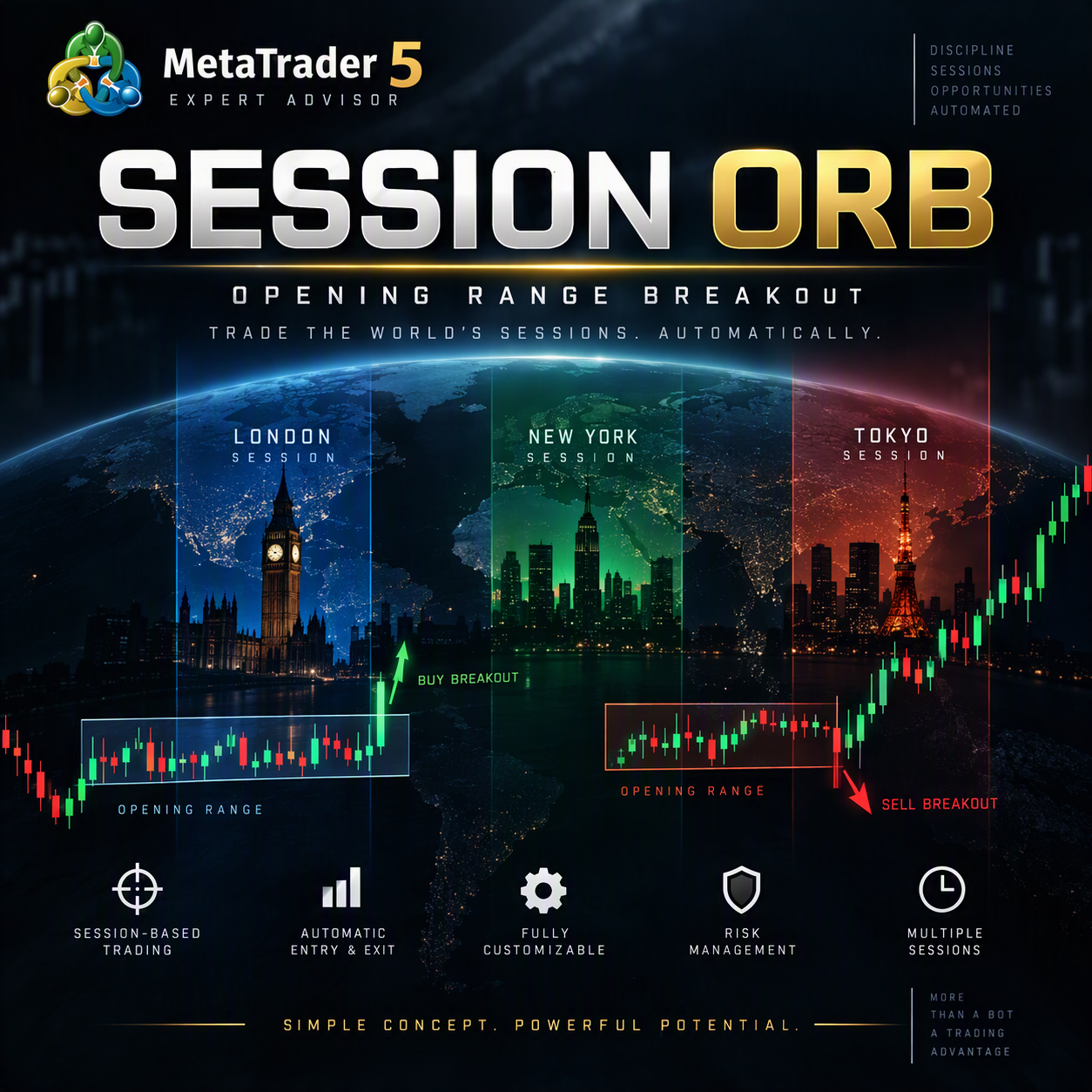
SessionORB EA
Multi-Session Opening Range Breakout Engine
Define the liquidity pool. Capture the volatility expansion. Manage the structural risk.
Most Opening Range Breakout (ORB) algorithms fail because they treat every minor price fluctuation as a valid range, leading to endless false breakouts in low-volatility environments. SessionORB solves this by combining strict time-based session definitions with dynamic volatility filters.
This algorithm maps the initial liquidity pools for up to four distinct global sessions, validates that the range possesses sufficient volatility, and executes precise breakouts only when institutional momentum confirms the directional expansion.
The Execution Architecture
The algorithm operates on a strict sequence of range definition, volatility validation, and breakout confirmation.
Phase 1: Range Definition and Volatility Validation At the start of a configured session (New Zealand, Tokyo, London, or New York), the bot calculates the highest high and lowest low over a specific time window (e.g., 30 minutes). Crucially, it does not blindly accept this range. It measures the range width against the 1-Hour Average True Range (ATR). If the range is smaller than the configured ATR fraction, the bot classifies the market as too choppy, invalidates the range, and skips the session entirely. This single filter eliminates the majority of false breakouts.
Phase 2: Breakout Confirmation and Entry Window Once a valid range is established, the bot monitors for a breakout.
- The Trigger: A breakout is only confirmed when a bar closes beyond the range high or low, plus a dynamic ATR buffer. This ignores intra-bar liquidity sweeps and stop-hunts.
- The Window: The bot will only execute entries within a defined time window after the range closes (e.g., 180 minutes). Breakouts occurring hours later are ignored, as the initial momentum has already decayed.
Structural Risk and Capital Preservation
SessionORB relies on the geometry of the range itself to dictate risk parameters, ensuring that stops and targets are mathematically aligned with the current market structure.
- Structural Stop Loss: The initial stop loss is placed at the exact opposite side of the opening range. If the breakout fails and price returns to the other side of the range, the structural thesis is invalidated, and the trade is cut.
- Measured Take Profit: The take profit is calculated by multiplying the width of the opening range by a configurable Risk-to-Reward ratio (e.g., 1.5x). This targets the logical measured move of the session's expansion.
- Automated Breakeven: Once the price moves in favor of the trade by a distance equal to 1x the range width, the stop loss is automatically moved to the entry price, creating a risk-free position.
- Session Trade Limits: The bot restricts the number of entries per session (e.g., maximum 2 trades). This prevents overtrading if the market experiences a false breakout followed by a reversal.
Institutional Circuit Breakers
- Daily Loss Limit: The algorithm tracks the account equity at the start of every server day. If the equity drops by a specified percentage, all trading is immediately halted until the next calendar day, preventing emotional or algorithmic revenge trading.
- Time-Based Exit: To prevent holding positions through rollover or low-liquidity periods, the bot can be configured to automatically close all open positions at a specific server hour (e.g., 20:00).
Visual Infrastructure and Transparency
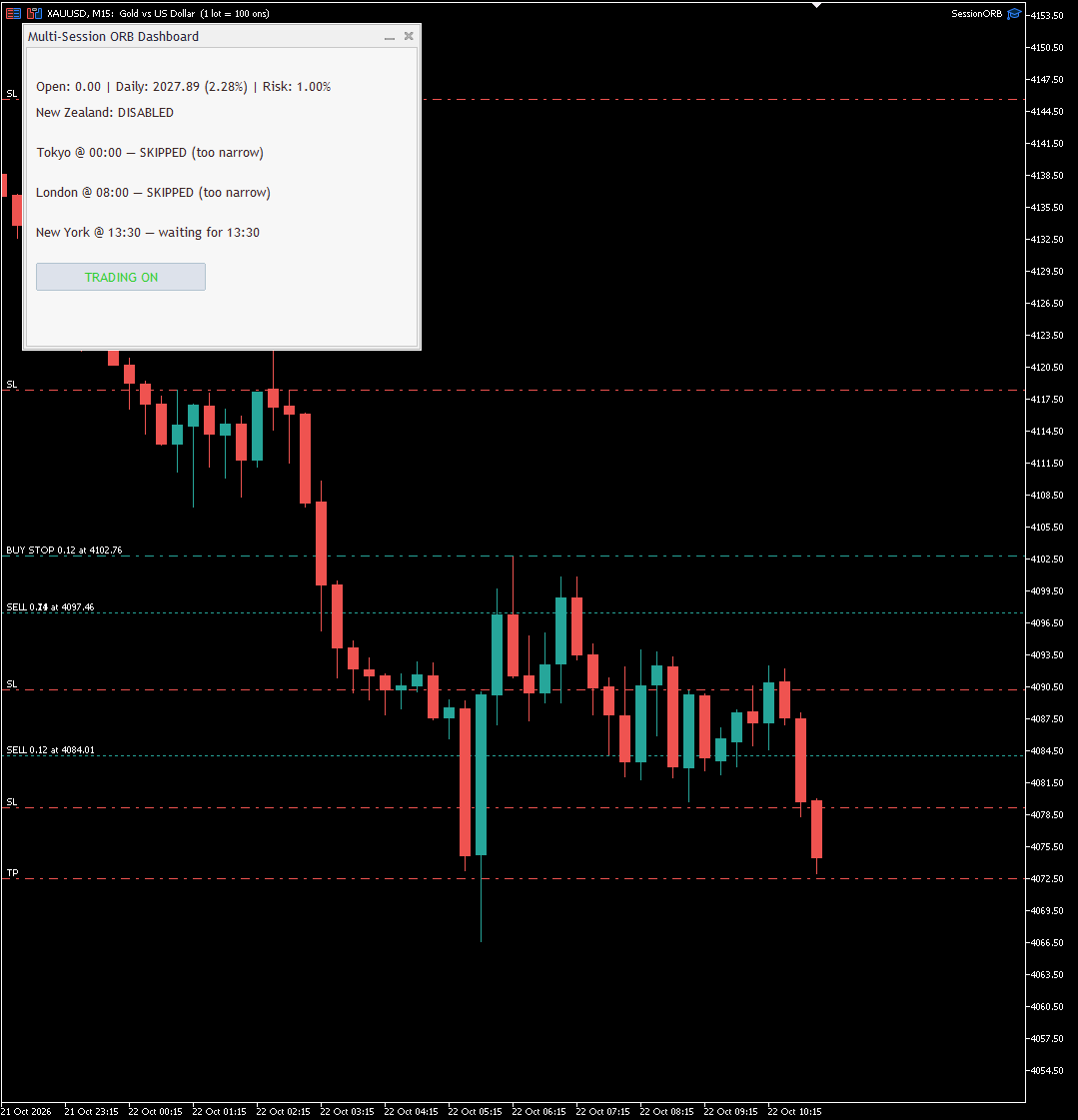
SessionORB features a comprehensive, interactive on-chart dashboard. It visually maps the opening ranges as rectangles on the chart, drawing the high and low boundaries. The dashboard provides real-time status updates for each of the four sessions (Waiting, Building, Active, or Skipped), displays open and daily P/L, and includes a physical toggle button to instantly enable or disable live trading without removing the EA from the chart.
Disclaimer
Trading foreign exchange and commodities (especially Gold/XAUUSD) on margin carries a high level of risk and may not be suitable for all investors. Past performance of the EA or backtested results does not guarantee future results. The high degree of leverage can work against you as well as for you. Before deciding to trade, you should carefully consider your investment objectives, level of experience, and risk appetite. There is a possibility that you may sustain a loss of some or all of your initial investment.
Results:
Version: Coming Soon
Add comment
Comments